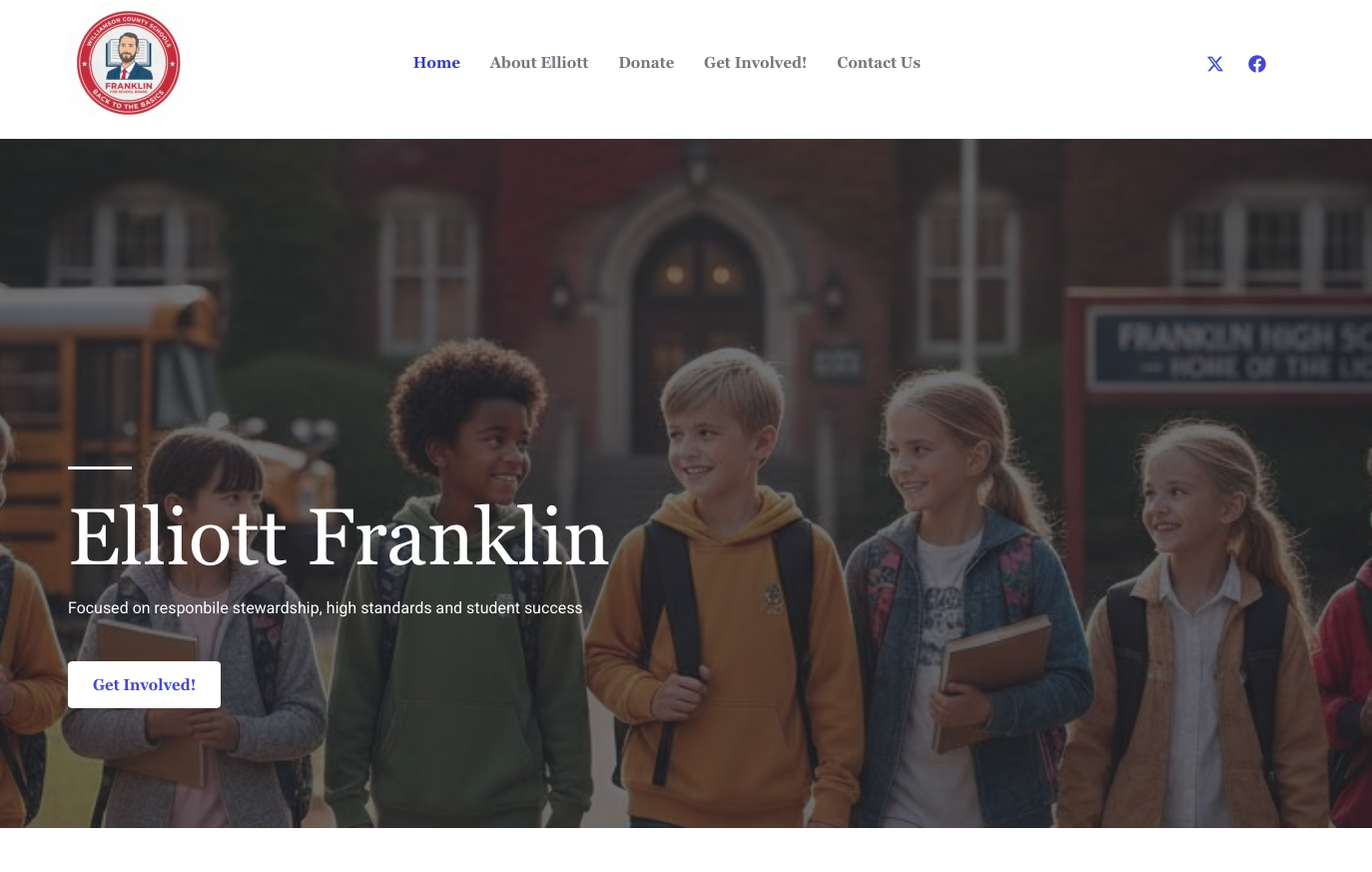
A Conversation with Elliott Franklin, running for School Board Member in District 10
Today, our Grassroots Spotlight features Elliott Franklin, who is running for School Board Member in District 10.
In this exclusive conversation, Elliott shares his vision to support Williamson County families (parents & students), stronger support for teachers through responsible budgeting, and outlines clear leadership objectives.
Q: What made you decide to run for school board now?
I’m running because today’s students are tomorrow’s employees, business owners, parents, and voters. The strength of our schools directly shapes the future workforce and civic health of Williamson County.
I ran in 2022 because I believe leadership matters in education, and that conviction hasn’t changed. In my professional life, I lead complex, regulated organizations where clarity, accountability, and long-term planning are essential. Schools deserve that same steady governance.
My wife and I have experienced public school, private school, and homeschool with our six children. Our oldest son graduated from Page High School.
Education isn’t theoretical for us. It’s about preparing young people for real opportunity and responsible citizenship.
Q: With our schools, what are some of the biggest challenges families are facing right now?
We are fortunate to live in a county with highly engaged parents and motivated students. That’s a strength. But we shouldn’t assume strong outcomes happen automatically.
Families want academic excellence, safe schools, and classrooms focused on factual instruction, not political advocacy. They also want confidence that growth and funding pressures won’t dilute quality.
We need to ensure every student, not just those with access to tutoring or strong support at home, receives a strong foundation in reading, writing, math, and critical thinking.
Q: If we check back in 12 months, what three clear wins do you want to be able to point to?
Clear reinforcement that classrooms remain academically focused and politically neutral.
A budget that prioritizes teachers and instructional resources while reviewing administrative overhead responsibly.
Measurable progress in core academic fundamentals, because those determine long-term success in college, career, and civic life.
Q: How will you stay in touch with parents, students, teachers, and principals (and prove their input actually shaped your votes)?
Leadership requires accessibility and transparency. I plan to hold regular community forums, maintain direct communication channels, and clearly explain my votes after major decisions.
If input influences my position, I’ll say so. If I disagree, I’ll explain why respectfully. People may not always agree with every vote, but they should always understand it.
Q: How do you improve student results without burning out teachers or micromanaging classrooms?
The board governs; teachers teach.
Our responsibility is to set clear academic standards, ensure instruction remains fact-based and age-appropriate, and align resources properly.
Classrooms should focus on factual instruction, teaching students how systems work, how to think critically, and how to engage respectfully, without advancing political viewpoints.
At the same time, teachers deserve stability, clarity, and respect. By setting firm academic guardrails and reducing unnecessary bureaucracy, we allow educators to focus on strong instruction in the fundamentals.
Q: When an issue gets heated (curriculum, discipline, safety, etc.), what’s the best approach to handle it?
Stay calm, gather facts, and communicate clearly. Education issues can become emotional because families care deeply.
Leadership means lowering the temperature and raising the standard of discussion. Decisions should be guided by student outcomes and alignment with the district’s mission (not headlines or political pressure).
Q: How do you set priorities when schools need to do a lot of things well (not just test scores)?
Start with fundamentals. Strong reading, writing, and math skills open doors.
From there, we strengthen STEM, agriculture, the arts, financial literacy, public speaking, and athletics. All of these prepare students for a rapidly changing, technology-driven economy.
Test scores matter, but preparation for life matters more. Education should develop discipline, communication skills, resilience, and civic understanding, grounded in factual instruction.
Q: When you say “fiscal responsibility,” what does that look like day-to-day?
Fiscal responsibility starts with a simple question: are our resources positioned as close to students and classrooms as possible?
Every organization needs central support functions. But like any healthy organization, we should regularly evaluate whether our structure is lean, efficient, and aligned with our core mission.
If administrative overhead grows faster than classroom investment, that’s worth examining.
The goal isn’t to eliminate necessary support. It’s to avoid unnecessary complexity and ensure dollars are flowing where they have the greatest impact: teachers, instructional materials, and student support.
In my professional career, I’ve learned that strong organizations are disciplined about staying smart and lean. Schools deserve that same level of stewardship.
Q: What does good district leadership look like to you?
Good district leadership stays anchored to the district’s mission: challenging students to pursue excellence in academics, athletics, and the arts.
That means protecting instructional time, maintaining high standards, and ensuring classrooms remain focused on learning (not activism or activities that fall outside the core mission of education).
It also means transparency with parents, consistent application of policies, and accountability for results.
Leadership should be steady, principled, and disciplined — always asking whether decisions strengthen academic excellence or pull us away from it.
When a district stays focused on its core mission, students thrive and communities remain strong.
Q: When your term ends, what do you hope families and staff will say is better because you served?
I hope they’ll say the district stayed focused on academic excellence and mission alignment.
That classrooms were strong and politically neutral. That teachers were supported. That decisions were transparent. And that students were better prepared for college, career, and responsible citizenship.
Because when we prepare students well, our entire community benefits — economically, socially, and civically.
To learn more about Elliott's campaign, you can visit his website here: Elliott Franklin for School Board Member, District 10.
You can also connect with him on Facebook here.
Please forward this to anyone you know that would also be interested in supporting Elliott Franklin.
You can also view all the information on the upcoming Elections here.