A Conversation with Mary Smith, Candidate for Williamson County Mayor
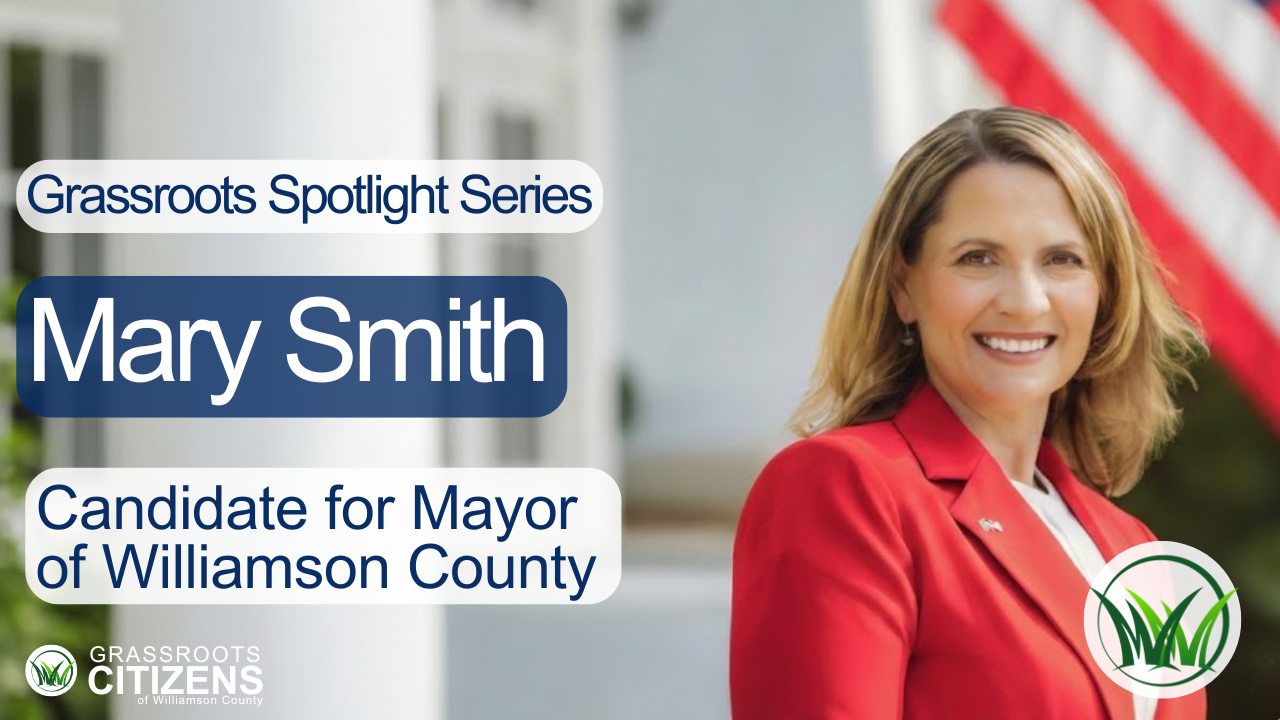
Today, our Grassroots Spotlight features Mary Smith, a Williamson County Commissioner running for County Mayor.
In this exclusive conversation, Mary shares her people-first vision to tackle traffic, debt, and preserve Williamson County’s identity.
Q: What does a county mayor do?
The simplest way to say it is — the County Mayor runs county government day-to-day. It’s the executive role. You’re responsible for making sure everything behind the scenes is working the way it should. That includes overseeing departments like public safety, budgeting and finance, planning and development, solid waste, facilities — all of the operational pieces that keep the county running. The school system operates separately, so that’s not under the County Mayor but most other county departments are.
One of the biggest responsibilities is the budget. The Mayor works with department heads and other elected officials to build a responsible, balanced budget and then presents it to the County Commission for approval. That means looking at revenue, managing debt, planning for growth, and making sure we’re being good stewards of taxpayer dollars.
The Mayor also hires and oversees department heads and the county attorney, and serves on several important boards and committees that help shape long-term strategy for things like healthcare, infrastructure, and growth planning.
At the end of the day, it’s a role that directly impacts your roads, your safety, your taxes, and the future direction of our community.
Q: Why are you interested in becoming County Mayor when you are currently a County Commissioner?
I’ve never really had political ambitions. So, for me, this started as a calling. About a year and a half ago, I began to feel very strongly that God was leading me into deeper public service. I never imagined I would run for office but in 2022, I stepped forward to serve on the County Commission, and that experience confirmed for me that this is exactly where I’m supposed to be.
I’ve worn a lot of hats in this community. I’ve been a small business owner. I’ve led teams and projects for global corporations. I’m a mom who has raised my family here. I’ve experienced Williamson County not just as an elected official, but as a resident, a taxpayer, and a parent. So, I know firsthand all the great things our county has to offer.
Serving on the Commission, I’ve seen firsthand both the opportunities and the challenges ahead of us. We have incredible potential but we need thoughtful leadership. Decisions should be grounded in data, guided by fiscally conservative principles, and focused on long-term sustainability.
I also believe it’s time to modernize how our county operates. With my background in technology and strategic management, I see real opportunities to upgrade systems, improve transparency, and make government more efficient and responsive.
For me, this race isn’t about a title. It’s about setting the tone and direction for the future of Williamson County, protecting what makes us special while preparing responsibly for what’s ahead.
Q: What’s your vision for Williamson County as Mayor?
We don’t need to reinvent Williamson County, we need to preserve the small-town values, rural beauty, rich history, and strong families that built it. At the same time, we must be fiscally responsible, manage growth carefully, and support the people who keep this county running.
I want to protect your voice, your wallet, and your future and be the Mayor, you know you can trust.
Q: How is your campaign different from the "way it's always been"?
I think what makes this campaign different is the energy behind it.
There’s a real groundswell of support not just from longtime friends but from people I had never met before serving on the Commission. They’ve watched me step up, ask hard questions, and sometimes put my neck on the line when it mattered. That kind of support doesn’t happen because of a title. It happens because people are ready for a choice.
And I believe voters deserve a choice.
Another difference is my focus on people-first governance. We talk a lot about buildings, projects, and growth but at the end of the day, government is about people. It’s about the families who live here and the employees who serve here.
So for me, this campaign isn’t about “how it’s always been.” It’s about thoughtful leadership, fiscal responsibility, and making sure both our residents and our workforce are prioritized as we plan for the future.
Q: How does your relationship work with the city mayors within Williamson County?
It’s really a peer relationship. We’re partners. City mayors focus on their municipalities, and the County Mayor focuses on county government, but our responsibilities overlap in important ways like infrastructure, public safety coordination, growth planning, and economic development. So, communication and collaboration are essential.
It should never be “us versus them.” It’s a team of leaders representing different parts of the same community. We may advocate for different priorities at times, especially as our municipalities continue to grow, but the goal should always be the same — a thriving, well-managed county that benefits everyone.
That does require open and honest conversations. Growth brings opportunity, but it also brings challenges. The County Mayor has to balance the needs of our cities with the needs of our rural areas and unincorporated communities.
At the end of the day, I believe we all want Williamson County to remain strong, prosperous, and distinct from anywhere else in the state. But as we grow, we must stay rooted in what made us successful in the first place and that is our rural beauty, our small-town values, and our commitment to faith, family, and service.
That foundation should guide every partnership and every decision.
Q: What have you found to be your most effective leadership skill in working with other elected officials?
It’s the ability to sit down and truly listen. You can’t walk into a room with a list of demands and expect collaboration. You have to understand where the other person is coming from, what their priorities are, what their concerns are, and who they’re representing.
Once you take the time to listen, you can usually find common ground. From there, it’s about building a plan that makes sense, that’s grounded in data, and that both sides can feel good about supporting.
At the end of the day, effective leadership isn’t about winning an argument, it’s about creating solutions that move the whole county forward.
Q: What are some of the issues you're hearing from people in Williamson County?
Without question, the number one issue I hear about is traffic.
I hear it at the grocery store, at community events, at work — and it shows up consistently in responses to my survey. It’s not just congestion itself. It’s what traffic represents. It’s less time with family. It’s daily stress. It’s the feeling that growth is happening faster than our infrastructure can handle.
People chose Williamson County for a certain quality of life. They didn’t move here to watch it turn into a gridlocked metro area.
Q: Do you have a potential solution for the traffic issue?
There isn’t a single silver bullet, and I think it’s important to be honest about that. Traffic is the result of growth outpacing infrastructure. So, the solution has to start with rebalancing that equation. That means infrastructure first, rooftops second.
It’s going to require strong coordination between county government, our municipalities, and the state. Many of the major corridors are state-controlled, so advocacy at the state and even federal level is critical. The County Mayor has to be at the table — consistently — pushing for prioritization, funding, and realistic timelines.
Here locally, we can work with our highway department and city partners to relieve pressure on secondary roads, improve traffic flow, and make strategic improvements that reduce bottlenecks.
But ultimately, this is about leadership and collaboration. My role would be to ensure Williamson County has a strong voice in every conversation, to bring forward actionable plans, and to keep infrastructure planning aligned with growth so we protect our quality of life moving forward.
Q: How do you balance development with managing debt?
It starts with discipline.
Growth brings opportunity especially when world-class companies choose to locate here. That creates the potential for smart public-private partnerships and alternative revenue streams that can help fund quality-of-life amenities without placing the entire burden on taxpayers.
But we also have to be realistic. Not every project is a need, some are wants. We should build what we truly need, when we need it, and make sure every capital project is thoroughly vetted so we’re getting the best value for every dollar spent.
I would also take a hard look at our debt management policies. We have significant obligations ahead of us — a new jail, juvenile center, judicial complex, and necessary school maintenance. Those are core government responsibilities. We can’t ignore them, but we also can’t simply pass the bill to future generations.
Balancing development with debt means being strategic, innovative, and disciplined. It means prioritizing infrastructure and essential services, pursuing creative funding partnerships where appropriate, and working intentionally to pay down debt over time, all while protecting property taxpayers.
That requires a steady hand and long-term thinking, not short-term decision-making.
Q: How can you help protect the rural parts of Williamson County against urban sprawl?
First, we must recognize that our rural character is part of who we are. Agriculture is literally on our county seal.
People move here and visit here because they want to see rolling hills, farmland, and open space not unchecked development. If we lose that, we lose what makes Williamson County distinct.
Protecting rural areas starts with policy. That means supporting zoning and growth plans that respect rural boundaries, advocating for land preservation initiatives, and being thoughtful about where and how development happens.
But it also means supporting our farmers. I see a real opportunity to partner with UT Extension and others to promote agricultural education and remind people of the economic and cultural value of farming. We should also continue advocating at the state and federal levels for policies that make it viable for farmers to keep farming so selling to developers isn’t their only option.
At the end of the day, protecting our rural areas comes down to being intentional. We have to make decisions that allow growth where it makes sense while keeping our charm without selling the farm.
Q: What's the county mayor's role in county infrastructure, especially in light of recent storms?
First, I have to say I’ve never been prouder of our county employees than I was during the recent storms.
We had deputies, emergency personnel, and even animal shelter staff staying overnight to make sure residents and animals were safe. Public works crews were out clearing roads. It was an incredible example of servant leadership in action.
The County Mayor plays a key role in infrastructure readiness and response. That includes ensuring our emergency management systems are coordinated, departments are properly funded, and we’re investing in resilient infrastructure before a crisis hits — not after.
When it comes to utilities, some of those systems are regulated at the state level. For example, Nashville Electric Service is governed regionally, and currently Williamson County doesn’t have representation on that board. That’s something we should be advocating for. If our residents are impacted, we deserve a voice at the table.
Q: Does it go back to being an advocate for the county?
Ultimately, the Mayor’s role is both operational and strategic, making sure we’re prepared locally, supporting our frontline workers, and advocating at the state level when policy decisions affect our residents.
Storms test leadership. And preparedness, coordination, and strong advocacy make all the difference.
Q: What’s going on with the hospital (Williamson Health)?
There are ongoing conversations about the long-term future of Williamson Health, including whether a sale should even be considered.
My role right now is to listen carefully, gather facts, and ensure that any decision is made thoughtfully not rushed. This is a community asset that has served our residents for decades. It deserves transparency and full public engagement.
If there were ever to be a transaction, it’s important to remember this is a taxpayer-created asset. Any proceeds should be handled with clear oversight and accountability. Those funds should not be directed by unelected parties without public input. The County Commission, as the elected body representing taxpayers, should absolutely play a role in oversight.
At the end of the day, patient care, fiscal responsibility, and public trust all have to guide the process. This decision is too important to approach any other way.
Q: If someone was new to Williamson County, what do you want them to know about you?
I’d want them to know that I moved here for the same reasons they probably did.
My family has called Williamson County Home for more than 20 years. My children were born here, raised here, and educated here. I’ve experienced this community not just as an elected official, but as a mom, a neighbor, and a taxpayer.
I understand how county decisions affect families every day from traffic to schools to property taxes because those decisions affect my family too.
At my core, I have a heart for service. I’m not chasing a title. I’m stepping forward because I believe in the responsibility that comes with leadership and the opportunity to make a meaningful difference.
I care deeply about this county, and I want to help protect what makes it such a special place to call home.
Q: How can people contact you? Are you accessible?
Yes, communication is key. There are multiple ways to get in touch: email, my monthly newsletter, and social media (Facebook, X, Instagram, Nextdoor). The best way to ensure you receive a response is by email at mary@votemarysmith.com. You are also welcome to call me at (615) 629-9830.
To learn more about Mary's campaign and her stance on key issues, you can visit her website here: VoteMarySmith.com