

A Conversation With Janet Curtis About Preserving Rural Williamson County Through Annexation Reform
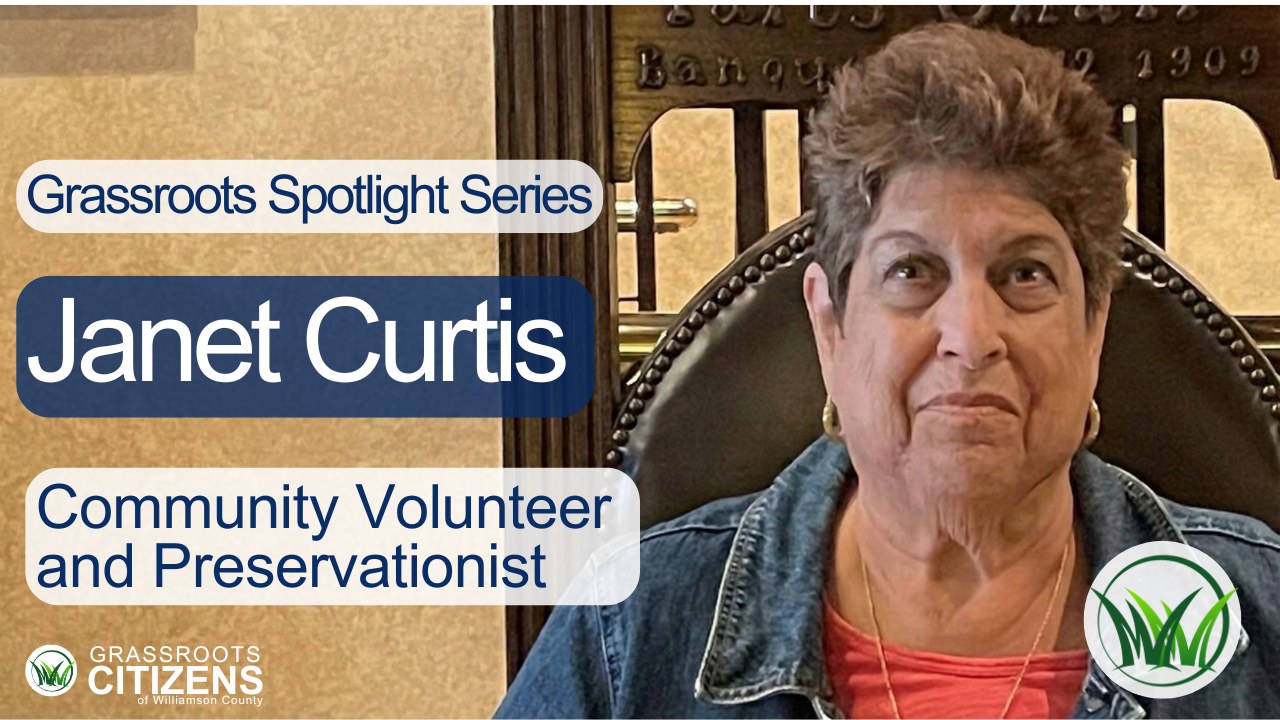
Today, our Grassroots Spotlight features Janet Curtis, a Community Volunteer and Preservationist, who actively works to maintain Williamson County's rural charm.
In a recent conversation, Janet sheds light on annexation reform and how that directly affects Williamson County residents.
Q: Who are you and what do you do?
My name is Janet Curtis, and I have lived in Franklin, TN, for the past 35+ years. I'm married to a native Tennessean born at Vanderbilt Hospital and a graduate of East High School. I am retired and devote my time to trying to keep Williamson County rural.
Q: What prompted you to get involved?
I became involved back in 2017 when the Mayes Creek Basin was being threatened with a high-density, commercialized development that residents didn’t want built.
Q: How do cities annex rural county land, and how does that create unchecked growth?
In order for a property to be annexed into a city, the property owner must request annexation in writing. It is then placed on the agenda for discussion, and the board of mayor and aldermen vote on whether to move the process forward.
This happens if they believe the annexation is feasible. It then goes to the city planning commission, which will either approve it and send it back to the board of mayor and aldermen with their recommendation or advise against it. It then returns to the board of mayor and aldermen for three readings and public hearings.
On the third reading, they vote for or against the annexation. This results in unchecked growth because the Franklin School District boundaries are locked, meaning that any property that gets annexed sends students to county schools. The county has had to build more schools, which accounts for a significant portion of the school debt.
There is no financial impact information provided to the county, so officials have no idea what the annexation will ultimately cost them.
Q: What is happening on February 9th that is important to preserving the character, charm, and quality of life in Williamson County?
There is a resolution being proposed that asks for the following:
That the county has more input before a property is annexed into a municipality, so officials know what it will cost them. Currently, this information is not provided. This would give the county a chance to say, “No, we can’t afford the annexation.”
That non-contiguous annexation is not allowed. Currently, it is permitted by state law, but it creates islands of city property surrounded by county property, which complicates emergency services, road maintenance, and other logistics.
That before property is placed into the Urban Growth Boundary, property owners be notified in writing. It also states that if a property owner wants to be removed from the Urban Growth Boundary, they can request removal in writing.
These are just a few examples of what is included in the resolution. It is important that it passes because it addresses the rights of county property owners who, so far, have had very little say in what can be built around them.
Q: Can you explain the issue with non-contiguous annexations? How does that affect county residents and emergency services?
Non-contiguous annexations allow a city (e.g., Franklin) to annex land that is not adjacent to its current borders, creating isolated “islands” of city jurisdiction surrounded by unincorporated Williamson County.
Some of the effects on county residents include:
A lack of representation: Surrounding unincorporated residents pay county taxes but have no vote on approvals or developments on the annexed island.
Added financial strain: High-density projects increase traffic, school needs, and infrastructure costs, which burden county taxpayers without the city contributing enough to offset the full cost.
Threats to the rural lifestyle: This accelerates sprawl, erodes farmland and open space, and disrupts the planned separation of urban and rural zones, as outlined in the Williamson County 2040 Land Use Plan developed with resident input.
Q: How does this county resolution fit into the broader plan of getting a bill passed at the state level?
This resolution is important because it asks that the county have more input when a municipality wants to annex property. It requests that, before an annexation is approved, the municipality provides a financial impact statement so the county understands the costs related to services such as roads, schools, and infrastructure.
This is important because we hope it will help slow the growth sprawl occurring in the county and preserve the rural character county residents want to maintain.
We also want this to pass so we can show state legislators that county commissioners support a bill requiring municipalities to provide financial impact statements prior to annexation.
This must be enacted at the state level to become law. A bill has already been written, and Senator Joey Hensley has agreed to sponsor it.
Q: The resolution also addresses Urban Growth Boundaries, requiring property owner notification and allowing them to opt out. Why is that important?
Municipalities would be required to notify residents when their property is included in the Urban Growth Boundary and allow them to opt out if they choose. This is important because many residents never realized they were even within the Urban Growth Boundary, which directly affects how their land can be used.
Currently, residents have no way to exit the Urban Growth Boundary except during the Growth Plan review, which occurs every five years. This is fundamentally a property rights issue.
Q: What kind of response are you seeing from Williamson County residents as you spread the word about the February 9th meeting?
So far, the response has been positive as people are notified about the meeting.
There will be a County Commission meeting to discuss the resolution appealing to the Tennessee General Assembly on Monday, February 9, 2026, at 6:00 p.m. at the County Administration Building, located at 1320 W. Main St., Franklin, TN 37064.
You can view a flyer with more information here.
Please forward this to anyone you know who may be interested in attending and preserving the charm and character of Williamson County.